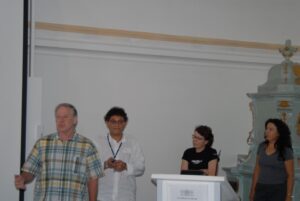
Dr. Sabri Bebawi, Fellow of the Salzburg Institute on Globalization
The middle of five children, Sabri Bebawi was born in 1956 in Fayoum, Egypt, where he attended law school at Cairo University. He then left Egypt for the United Kingdom. He was invited by Oxford University, where he spent some time, and never returned to Egypt. A few years later, after living and working in England, Italy, France, and Cyprus, he took refuge in the country he loved most, the United States.
In California, he studied communications at California State University, Fullerton, and then obtained a master’s degree in English education. Later, he worked at many colleges and universities, teaching English as a second language, freshman English, journalism, and educational technology. He did further graduate work at UCLA and obtained a PhD in education and distance learning from Capella University.
Although English is his third language, he has published many works in English on eclectic topics. His ambition has always been to write novels; this is his first attempt. As English is a foreign language to him, writing a book has been challenging.
As a child, Bebawi struggled to make sense of religions and their contradictions; in fact, he grew up terrified of the word God. As he grew older and studied law and all the holy books, he developed a more pragmatic and sensible stance; the word became just that—a word.
Bebawi’s stand of globalization is this: Globalization, while fostering interconnectedness and economic growth, has several adverse effects that cannot be overlooked. It often exacerbates income inequality, as wealth becomes concentrated in the hands of multinational corporations and affluent nations, leaving developing countries to grapple with low wages and exploitative labor practices. Cultural homogenization is another drawback, as local traditions and identities are increasingly overshadowed by dominant global influences, leading to the erosion of cultural diversity. Moreover, globalization significantly contributes to environmental degradation, as the surge in production, transportation, and consumption generates higher carbon emissions and depletes natural resources. Additionally, it exposes economies to greater vulnerability, as financial crises and market instability in one region can ripple across the globe, affecting even those nations that played no role in causing the disruption. These negative consequences underscore the need for sustainable and equitable approaches to global integration.
Lecturing At The Salzburg Insitute on Globalization, Salzburg, Austria